
Searchable.com covers AI search visibility at three levels: the answers AI engines give, the website those answers draw on, and the traffic that follows. This reference sets out what sits inside each level, how the main metrics are labeled, and what the platform does not measure.
| Area | Covered? |
|---|---|
| Brand mentions in AI answers | Yes, per prompt and per engine |
| Competitor comparison | Yes, through share of voice and top brands |
| Citations and cited domains | Yes |
| AI crawler visits to your site | Yes, through LLM analytics |
| Visits from AI engines | Yes, through GA4 and Search Console |
| Products in AI shopping results | Yes, through the AI Shopping module |
| Control over what engines say | No tool offers this |
Engines in Scope
[IMAGE: ai-engine-coverage-map.webp]
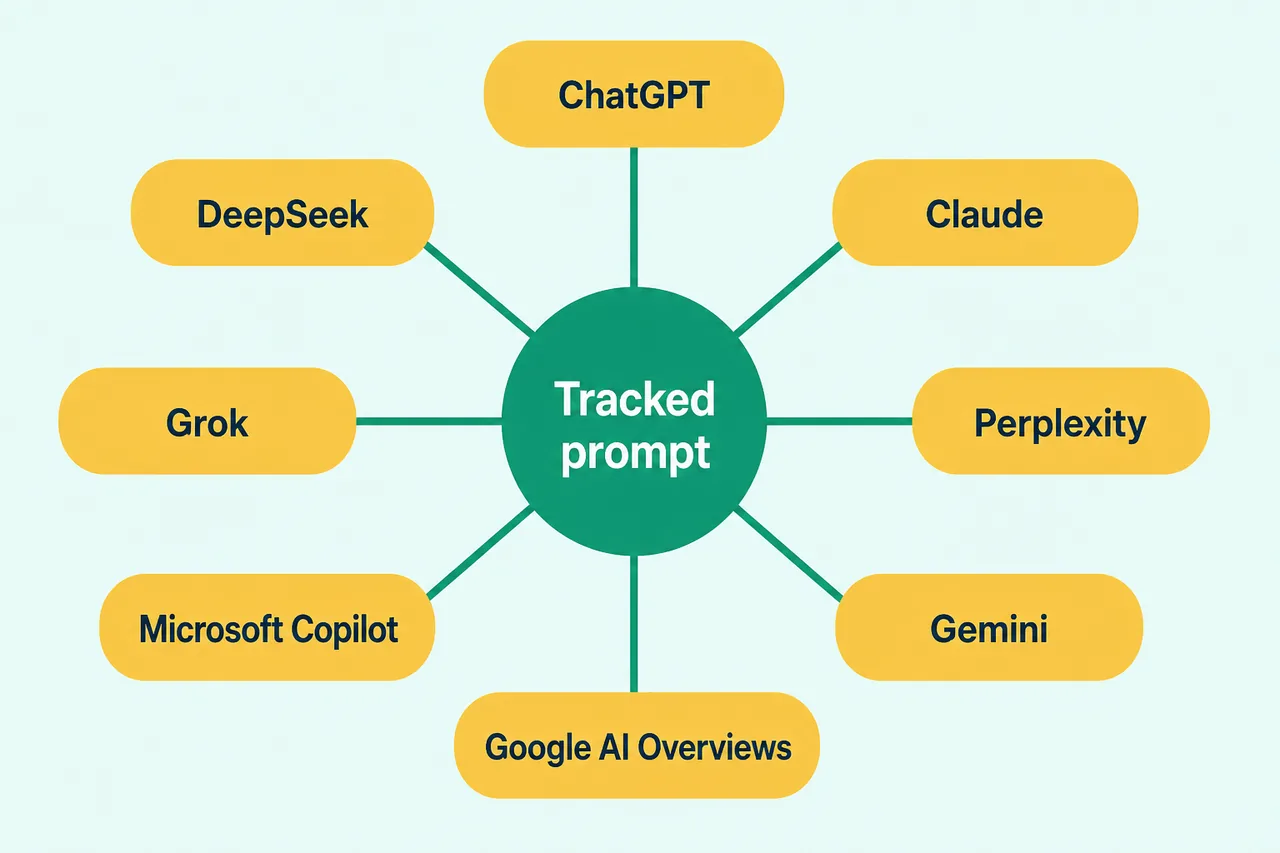
The pricing page lists eight engines, each checked against the same set of prompts so the results can be compared over time.
- ChatGPT, from OpenAI
- Claude, from Anthropic
- Perplexity
- Gemini, from Google
- Google AI Overviews
- Microsoft Copilot
- Grok, from xAI
- DeepSeek
Google appears twice for a reason. Gemini is Google’s standalone assistant, while AI Overviews appear inside Google Search results, so the two are separate surfaces and are tracked separately. The same applies to Microsoft, where Copilot is listed on its own.
Note. Sources differ on coverage. The pricing page lists eight engines, a May 2026 funding report mentioned ten, and the documentation says the engines tracked depend on your plan. This guide follows the pricing page.
Prompt-Level Metrics, Label by Label
Prompts are the questions you choose to track. Searchable’s prompts page lists the data each one can show, which doubles as a glossary for the dashboard.
| Metric | What the label indicates |
|---|---|
| Visibility score | How visible your brand is in answers to that prompt |
| Average position | Where your brand tends to appear among the brands named |
| Sentiment | Whether the language about your brand reads as positive or negative |
| Topic | The subject group the prompt belongs to |
| Intent | What the person asking is trying to get done |
| Demand | How much interest there is in the question |
| Platform coverage | Which engines the prompt has been checked on |
| Top brands | The brands that appear most often in the answers |
| Competitor context | How named competitors compare on the same prompt |
The evidence behind a score
Every score links back to answers. You can open the AI response behind a prompt score and see mentions, rank, sentiment, citations, cited domains, competitors and the recommendation language the engine used.
Good to know. Searchable’s public pages name these metrics but do not publish formulas for them. The descriptions above are plain readings of the labels, so check the in-app definitions before reporting on them.
Mentions, Citations and Sources
These three terms are easy to blur, and AEO Insights reports them separately. Share of voice, which compares your brand with competitors, sits alongside all three.
Mentions
A mention is your brand named in an answer. It is the base layer of visibility and share of voice.
Citations
A citation is a source the engine shows for its answer. Being cited means one of your pages fed the answer, which is a different signal from being named.
Sources
Sources are the domains engines draw on across a topic, including third-party sites. They show where a category’s answers come from, which may not be your site at all.
Example. An engine recommends a brand by name while citing a review site’s comparison page. The brand has a mention but no citation, and the review site holds the source position. (Illustrative scenario.)
Site Scores and Their Weighting
Searchable’s site audit scores each area from 0 to 100, and its documentation publishes the weights behind each score.
| Score | Components and weights |
|---|---|
| Technical | Page speed 30%, mobile optimization 25%, Core Web Vitals 20%, technical SEO 15%, crawlability 10% |
| Content | Quality 30%, keyword optimization 25%, structure 20%, internal linking 15%, metadata 10% |
| AEO | Structured data 25%, answer format 25%, citation worthiness 20%, semantic richness 20%, AI accessibility 10% |
How Overall Health is calculated
The three scores roll up into one figure. Overall Health equals Technical times 0.30, plus Content times 0.35, plus AEO times 0.35, so content and answer readiness together carry 70% of the weight.
Example. A site scoring 80 for Technical, 60 for Content and 60 for AEO has an Overall Health of 66, from 24 plus 21 plus 21. (Illustrative.)
Note. The documentation itself says higher scores generally mean better AI visibility, but it’s not 1:1.
Crawler and Traffic Data
LLM analytics records how AI bots request pages on your site. It connects through your host or content delivery network rather than through code in your application.
| Captured for each AI bot request | Never sent |
|---|---|
| HTTP method, path and host | Query strings |
| User agent and referrer | Request and response bodies |
| Country code | Headers other than User-Agent and Referer |
| Response status and timestamp | Full IP addresses |
Visits from AI engines
The AI Search Traffic module connects GA4 and Search Console to attribute visits that come from AI recommendations. That lets you read visibility and visits together, instead of in separate tools.
Tip. Crawler data shows whether engines reach your pages at all. OpenAI, for example, says sites that disallow its OAI-SearchBot will not be shown in ChatGPT search answers.
Shopping and Content Coverage
Two modules extend coverage beyond brand mentions in text answers.
- AI Shopping tracks product visibility, brand market share and merchant representation in AI shopping results.
- Content Studio builds articles from research-backed outlines and publishes to WordPress, Sanity and Contentful. Professional includes 20 articles a month and Scale 80.
AI Shopping matters most for retail brands, since product answers name merchants as well as products. Merchant representation shows which sellers an engine points to when it recommends your product.
Content Studio works from research-backed outlines, so it is most useful once tracking has run long enough to show which topics need new content.
Markets, Locations and Query Fan-Out
Answers can differ by place as well as by engine. AEO Insights includes location among its views, and the Scale plan adds multi-country and region tracking, which Professional does not list.
Query fan-out is the other reason coverage is broader than a single question. Google describes it as AI features issuing multiple related searches across subtopics and data sources to build one answer, so a page can be drawn in by a sub-question you never targeted.
Good to know. Searchable lists query fan-out alongside topics and location in AEO Insights, so the related searches behind an answer can be studied, not just the final text.
Alerts, Connectors and Data Access
Coverage also means how the data reaches you. Several routes are listed across the site and documentation.
- Alerts flag brand mentions and ranking changes.
- Slack and Linear integrations connect the platform to team chat and to engineering backlogs.
- The ChatGPT connector, launched in August 2026, answers questions about visibility, share of voice, sentiment, citations and crawler activity inside ChatGPT.
- API access, listed on the Scale plan, opens the data to your own reporting.
What Searchable.com Leaves Outside AI Search Visibility Tracking
No tracker controls what an AI engine says. Searchable records answers, scores your site and suggests work, but the engines decide what to mention and cite.
A few gaps follow from how AI search works rather than from the product itself.
- Engines that are not on your plan, or not on the list, are outside the data.
- A score summarizes the answers checked, which are samples of what an engine says, not a fixed ranking.
- Google folds AI feature traffic into the Web totals in Search Console, so any split by feature comes from somewhere other than Google’s report.
- Site scores guide work on your pages. They do not forecast citations.
A Good Fit When, and When It Is Not
A good fit when
You need to see answers across several AI engines, not just Google, and compare your share of voice with named competitors. You can list 50 to 200 real buyer questions, the range Searchable’s documentation says most businesses find enough, and someone on the team will act on audits and content suggestions. Agencies add a further reason, since Scale covers unlimited domains and offers API access for client reporting.
Probably not yet when
Google is your only channel and Search Console already answers your questions, or you cannot yet name 10 prompts worth tracking. In that case, free first-party data and a handful of manual checks are a sensible starting point before a paid tracker. Bing Webmaster Tools now reports Copilot citations for free, and Search Console includes AI feature traffic in its Web totals.